Spotify’s Effect on Consumer Behaviour

Spotify’s Social InfluenceHow Spotify Creates Conformity

Spotify actively participates in Social Identity Theory. Which is a theory argues that each of us has several ‘selves’ that relate to groups, hence we have an internal need to think of our-self as a collective and not an individual.

This can be shown in the facebook connect function. This allows us to see what our friends are listening to and they can view ours. These friends due to social influence we may influence us to listen to similar music they are listening to. An example of this in Article: Effects of group pressure upon the modification and distortion of judgment by Whittaker JO. Which highlighted that it only takes a majority of 3 people for us to conform our behaviour to match theirs.
Untitled

We may likewise pursue social standards in tuning in to what is ‘the standard, for example, Drake, and abstain from tuning in to tunes that conflict with social standards. This does not span to Spotify, numerous apps ask you to login through various social platforms 

Consumer Attitudes of Spotify- How consumers view Spotify

Spotify’s Consumers have formed their attitude on Spotify through their direct personal experience with the company, which is considered a one of sources of influence on attitude formation (see image below), examined in the article Johnson N in the article Opinions and Personality.

Capture

This direct connection has led Consumers to be highly responsive towards Spotify.
This is shown especially in, Spotify’s customer service department, which is
highly regarded by its customers. For example, when Spotify’s app crashed.
Spotify remedied this situation through responding to customers’ concerns
promptly and across all channels and continued this type of customer engagement
long after the problem was fixed. Spotify went so far as to give every
complained customer a personalized message in playlist form (Image below).

Spotify help messager

Conditioning- Spotify’s Use of Instrumental Conditioning (Positive Reinforcement)

Spotify has also been known to engage instrumental conditioning in terms of both positive reinforcement and negative reinforcement.

Spotify has used positive reinforcement as recently as 2016, through it’s Rock star Rewards Program. In this program any Spotify member who applies in the Spotify Rock Star Program can earn points for finding new people and exposing those people to Spotify and new songs that they would enjoy. These points were published every 3 months and can be redeemed for prizes (below).

Spotify also engages in negative conditioning through it’s free version, of which the users played music will be stopped to play an add encouraging them to go to a paid subscription. This negative effect on the customer prompts customers to upgrade to a premium plan without ads preventing them from enjoying their service at any pay point. 

Audio Ad Example: https://www.youtube.com/watch?v=dk5sdECaJCY&ab_channel=Wolfborgg 

The article by Chris Janiszewski, in the article “The Influence of Classical Conditioning Procedures”. Helps to state that positive reinforcement is more effective than negative reinforcement for brands due to the benefit of brand loyalty


Reference List

Whittaker JO, Meade RD. Social pressure in the modification and distortion of judgment: A cross-cultural study. International Journal of Psychology. 1967;2(2):109-113. doi:10.1080/00207596708247207. Accessed May 26, 2019

Johnson N. Opinions and Personality: Brown on the Law. Houston Law Review. 2010;(Issue 3):553. https://search-ebscohost-com.ezproxy.uow.edu.au/login.aspx?direct=true&db=edshol&AN=edshol.hein.journals.hulr47.24&site=eds-live. Accessed May 26, 2019.

Janiszewski C, Warlop L. The Influence of Classical Conditioning Procedures on Subsequent Attention to the Conditioned Brand. Journal of Consumer Research. 1993;20(2):171-189. https://search-ebscohost-com.ezproxy.uow.edu.au/login.aspx?direct=true&db=bth&AN=9401112111&site=eds-live. Accessed May 26, 2019.

Spotify’s Social Influence

How Spotify has changed the way we listen to music

Spotify has reformed the manner in which we tune in to music with a great many melodies accessible to tune in to at our relaxation. Be that as it may, with this online administration comes the social impact of other Spotify clients, affecting which tunes we tune in to.

The Social Identity Theory expresses that piece of our self-idea originates from our enrollment to a social gathering. We make ‘in-gatherings’ which we see ourselves having a place with and ‘out-gatherings’ who we see as being not quite the same as us. Enrollment to the in-bunch adds to our confidence, so we perform conduct which guarantees that we are like the in-groups.

How Spotify Increases Conformity

As our Spotify account can be connected to our Facebook account, we can see our companions’ listening action on the correct sidebar and they can see our own. These companions may frame some portion of our apparent ‘in-gathering’ and based on this idea we may tune in to comparative music they are tuning in to.

We may likewise pursue social standards in tuning in to what is ‘the standard, for example, Drake, and abstain from tuning in to tunes that conflict with social standards when we are on an “open” listening session.

Another presentation of congruity is the playlists which Spotify prescribes, for example, ‘Today’s Top Hits.’ In tuning in to playlists like this, we accept that we will like the melodies for reasons unknown other than in light of the fact that other individuals do. We at that point trust we do like these tunes more as an unavoidable outcome.

A Study Conducted of Spotify’s Social Influence

Participants downloaded previously unknown songs either with knowledge of previous participants’ choices or without any information about previous downloads. The success of a song was more unpredictable in the social influence condition than in the independent condition. It is hard to predict when social influence will cause one particular song to gain popularity and take off as a ‘hit’.

Conclusion

What can we learn from this? We are more influenced by others’ music preferences than we perhaps think and our music choices are less independent. I have started to stay on a “private” listening session and I have turned off the right sidebar. If we take out of consideration what everyone else is listening to, we can choose what we ourselves want to listen to and not worry about being judged.

References

Asch, S. E. (1951). Effects of group pressure upon the modification and distortion of judgment. In H. Guetzkow (ed.) Groups, leadership and men. Pittsburgh, PA: Carnegie Press.
Moscovici, S. and Zavalloni, M. (1969). The group as a polarizer of attitudes. Journal of Personality and Social Psychology, 12, 125-135.
Salganik, M.J., & Dodds, P.S., & Watts, D.J. (2006). Experimental Study of Inequality and Unpredictability in an Artificial Cultural Market. Science, 311(5762), 854-856.
Tajfel, H. ( 1981). Social stereotypes and social groups. In J. C. Turner & H. Giles (Eds.), Intergroup behaviour (pp. 144-167). Oxford: Blackwell.

Consumer Attitudes of Spotify

What attitudes do consumers have of Spotify

Supporters of Spotify’s music stream, love Spotify based on various predetermined attitudes of which they view the service, these include: Variety, Discovery and Collaborative.

Variety: Spotify offers everything that all of its competitors have. Their bread and butter is a library of millions of songs and a massive number of playlists created by users and Spotify’s editorial team.On top of that, users can access podcasts, video content and Pandora-like radio stations.Basically, Spotify has turned themselves into a one-stop shop for all of your music streaming wants and needs.

Discovery: Spotify has truly separated themselves through leveraging data for personalizing the experience of listening to and discovering music.From its machine-learning and data sifting technology, Spotify analyzes your listening habits and builds out customized recommendations, such as playlists and music suggestions based on the genres and artists you’re listening to regularly.

Collaborative: If you create a playlist, you can invite friends to be creators, which lets everyone included add songs to the playlist. This makes for a more shared experience with the platform, which is how music is generally best enjoyed.All in all, Spotify has a ton of features and capabilities to offer its users to keep the user experience constantly fresh and interesting. 

The Relationship between Spotify and their Customers

Consumers respond highly positive to Spotify. As their is a strong line of communication with customers, with any changes that Spotify may implement ranging from the products interface to the colours of it’s logo’s. Also Spotify’s customer service is highly regarded by it’s customers by example, when Spotify’s app crashed. Spotify remedied this situation through responding to customers’ concerns promptly and across all channels, and continued this type of customer engagement long after the problem was fixed. Spotify went so far as to give every complained customer a personalized message in playlist form.

Spotify was ranked as one of the top five customer-obsessed brands because it continually works to uncover and act upon evolving customer insights to improve the overall experience. But the company doesn’t stop there; they embrace customers as partners by taking co-creation, collaboration and participation to entirely new levels. Spotify creates a “Discover Weekly” playlist for each user based on what they’ve listened to recently. This allows Spotify to help its users discover and enjoy new music every week.

Bibliography

Kapelonis, C. (2019). The currency of Spotify: How it changed the way we discover music – Digital Innovation and Transformation. [online] Digit.hbs.org. Available at: https://digit.hbs.org/submission/the-currency-of-spotify-how-it-changed-the-way-we-discover-music/ [Accessed 12 May 2019].

Medium. (2019). The Key To Spotify’s Brand Relevance: They’re Customer-Obsessed. [online] Available at: https://medium.com/@ProphetBrand/the-key-to-spotifys-brand-relevance-they-re-customer-obsessed-99c3d8f7fe78 [Accessed 10 May 2019].

INC, S. (2019). Spotify’s core values. [online] HR Blog. Available at: https://hrblog.spotify.com/2016/09/02/spotifys-core-values/ [Accessed 15 May 2019].

Spotify’s Motivation and Values

Introductory Summary

Motivation can be characterized as different interior and outer elements that animate want and vitality in individuals to be persistently intrigued and focused or allows them to achieve an objective, organizations can be motivated in different ways (biological or learned needs). While values in a marketing setting is considered as the degree to which a product or services address the customers issues or needs. Organizations can create value through customer service or increased quality.

Aspects of Spotify’s Motivation

It is believed that Spotify uses Drive Theory. Which can be described as behavior that focuses on biological needs that produce unpleasant states of arousal (e.g. a grumbling stomach). This can be shown through their use of ads, which stops their music play to play an audio ad reminding them of the ad free premium version, this is used to motivate their customers to purchase premium.

Another aspect of motivation that can be attributed to Spotify is Maslow’s Hierarchy of needs, which is a five-tier model of human needs, often depicted as hierarchical levels within a pyramid. Within this Pyramid, it is believed that Spotify’s main product of music, can with self-esteem(but it can vary between stages as it depends on the value of music in your life). As for most people music is a motivator and is an enriching experience.

Spotify’s Values

Spotify as a business has various terminal values that govern the way they make decisions, these include Innovation, Collaborative, Sincere, Passionate and Playful. Spotify describes these values as “capturing the beliefs that we have about how we should conduct ourselves that are in line with our culture”. Spotify’s values helps to give the company commonly shared ideologies used to rally around all external and internal stakeholders, as they guide them company in the face of diversity.

Spotify, also has a instrumental value (Goals endorsed because they are needed to achieve desired end states, or terminal values). Which is spurring creativity, this is reflective of their company mission station “Our mission is to unlock the potential of human creativity—by giving a million creative artists the opportunity to live off their art and billions of fans the opportunity to enjoy and be inspired by it”. This helps to remind employees align their actions to their terminal values.

Bibliography

Mcleod, S. (2019). Maslow’s Hierarchy of Needs. [online] Simply Psychology. Available at: https://www.simplypsychology.org/maslow.html [Accessed 7 May 2019].

En.wikipedia.org. (2019). Expectancy theory. [online] Available at: https://en.wikipedia.org/wiki/Expectancy_theory [Accessed 7 May 2019].

The Hustle. (2019). This is Spotify’s Best Feature… And No One Ever Talks About It. [online] Available at: https://thehustle.co/spotify-spoken-word [Accessed 7 May 2019].

BusinessDictionary.com. (2019). What is value? definition and meaning. [online] Available at: http://www.businessdictionary.com/definition/value.html [Accessed 7 May 2019].

BusinessDictionary.com. (2019). Which of your friends needs to learn this term?. [online] Available at: http://www.businessdictionary.com/definition/motivation.html [Accessed 7 May 2019].

Whatley, S. (2019). Spotify’s core values. [online] HR Blog. Available at: https://hrblog.spotify.com/2016/09/02/spotifys-core-values/ [Accessed 8 May 2019].

Spotify. (2019). Spotify — Company Info. [online] Available at: https://newsroom.spotify.com/company-info/ [Accessed 8 May 2019].

Brand Personality- Spotify

Definition of Personality in a Brand Context

Brand personality is a set of human characteristics that are attributed to a brand name. A brand personality is something to which the consumer can relate; an effective brand increases its brand equity by having a consistent set of traits that a specific consumer segment enjoys

Description of Spotify’s Brand Personality

Spotify’s brand image when it was first launched has been in flux and in change, starting with a surprisingly sedate: black, white, and an uninspiring green for colours and a little stylised sound wave as a logo. But over time it has gained a solid brand identity that has helped to help its brand personality.

It’s new changed brand personality is based on its target market of 18 to 25 years old’s and displays a new impactful and bright colour scheme. The goal of the new brand identity was to create a look that would signal to the brand’s core audience of millennial’s that Spotify was as rich and lively as the music culture it fronted, rather than simply a technology service that served up songs.

What Personality Theory does Spotify Emulate

It is believed that Spotify’s personality creation is based on the trait personality theory. The trait personality theory can be defined as a theory of personality that focuses on the measurement of specific psychological characteristics. This can be seen in Spotify’s brand personality as it has the key trait of of being creative based on its highly colourful brand image, which is also a key trait of their target market.

When Spotify was asked why they have changed their brand image they responded with,” millennials share two distinct traits that were central to this project: they’re highly visual and they want a hand in co-creation and your new brand personality reflects that”

Bibliography

Investopedia. (2019). Why Some Brands Are More Attractive Than Others. [online] Available at: https://www.investopedia.com/terms/b/brand-personality.asp [Accessed 30 Apr. 2019].

Fast Company. (2019). Spotify Unveils A Bold New Brand Identity. [online] Available at: https://www.fastcompany.com/3043547/spotifys-new-look-signals-its-identity-shift [Accessed 30 Apr. 2019].

Pantelić, T. (2019). Spotify Presents a New Brand Identity Targeting Millennials | Brandingmag. [online] Brandingmag. Available at: https://www.brandingmag.com/2015/03/19/spotify-presents-a-new-brand-identity-targeting-millennials/ [Accessed 30 Apr. 2019].

Spotify’s use of Conditioning

Use Classical Conditioning

Classical Conditioning was created by John Watson. Spotify has instances of them using this concept (Occurs when a stimulus is paired with another stimulus that elicits a known response that elicits a known response to produce the same response when used alone) in their service.

In particular with their running feature, in which if you are feeling tired Spotify will play a song that you have chosen, that gives you a positive reaction, allowing you to run for longer. In turn, this allows to not only allow you achieve your running goals. The positive feelings of that song that plays that is associated with that running activity, helps to create a sense of satisfaction towards the product.

Use of Instrumental Conditioning (Negative Reinforcement)

Spotify uses an uncommon use of Instrumental conditioning called negative reinforcement (Negative reinforcement is a term described by B. F. Skinner in his theory of operant conditioning. In negative reinforcement, a response or behavior is strengthened by stopping, removing, or avoiding a negative outcome).

Spotify engages in negative conditioning through it’s free version, which of limits the users access certain features or services and to listen to music for free with frequent advertisements (which can be only gained through subscribing to their premium function). This negative effect on the customer prompts customers to upgrade to a premium plan without preventing them from enjoying their service at any pay point.

Use of Instrumental Conditioning (Positive Reinforcement)

Spotify has also been known to engage in the common common use of instrumental conditioning named positive reinforcement (a reinforcing stimulus, when a favorable outcome, event, or reward occurs after that particular action, in which that particular response or behavior will be strengthened in future cases.)

Spotify has used positive reinforcement as recently as 2016, through it’s Rock star Rewards Program. In this program any Spotify member who applies in the Spotify Rock Star Program can earn points for finding new people and exposing those people to new songs that they enjoy. These points are published every 3 months and can be redeemed for prizes (below).

Bibliography

Anon, (2019). [online] Available at: http://www.insideradio.com/free/research-spotify-s-perception-on-the-rise-with-consumers/article_b79d907c-000e-11e8-a5a2-330a267571be.html [Accessed 3 Apr. 2019].

Oba, D. (2019). Is Positive Reinforcement the Secret to Customer Behavior?. [online] Blog.smile.io. Available at: https://blog.smile.io/is-positive-reinforcement-the-secret-to-customer-behaviour [Accessed 5 Apr. 2019].

Community.spotify.com. (2019). Rock Star Program Points & Rewards. [online] Available at: https://community.spotify.com/t5/Community-Blog/Rock-Star-Program-Points-amp-Rewards/ba-p/1311728 [Accessed 5 Apr. 2019].

Spotify’s Perception

Consumer Perception

Consumers Interpret Spotify image by the 5 keywords vibrant, youthful, trending, Unique, contemporary and enthusiastic. With their most avid brand personalities of Simplistic, Cool and Excitement. Which is apart of their positioning. As Spotify is positioning can be described as effective as it is done in accordance to their brand image as their advertisements are cool and simplistic in description with an excited tone (audio ads). It is this positioning that has made Spotify effective in varying and separating themselves from their competitors.

How Spotify ad’s are effectively designed

Spotify’s current brand image can be seen in it’s advertisements. Of which has lead to financial benefit as is mostly comprised of online advertising and are low in cost, with a large percentage of their advertising is done on their own Application/Website. In which their free users are advertised to through Audio Ads (30 seconds of audio which plays between songs), display songs (images found on the banner and around the screen) video advertisements (a video with connected audio is played between songs). Spotify’s advertising is effective as it mostly online, hence where their target market is most likely to be advertised to.

Campaigns to enhance their perception to consumers

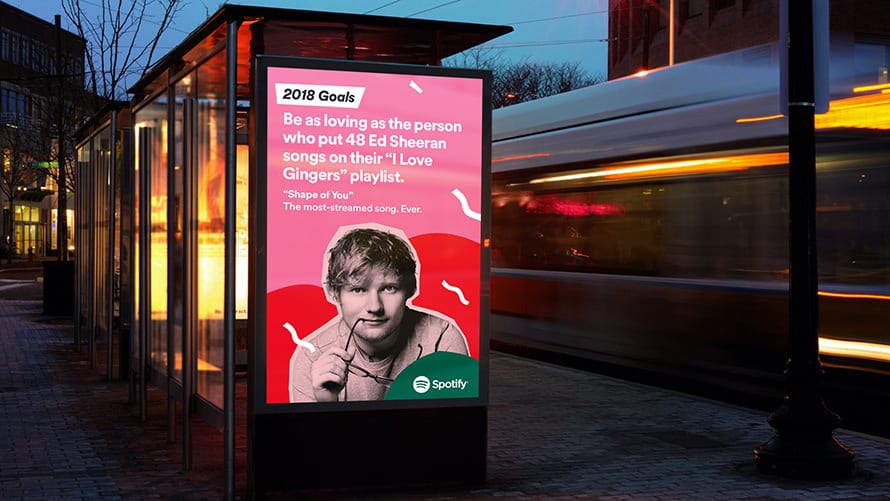
Spotify at the end to 2017 chose to add humor into their brand perception with their “2018 Goals” campaign. The campaign was focused around anonymously releasing their user data in a comedic fashion. Billboards and poster were the platform and Spotify took to the streets to out their users weird and wonderful habits, but in an jesting anonymous way.

data analytics spotify

Spotify Perception Survey: https://www.surveymonkey.com/r/8DKB7RT

Bibliography

Surveymonkey.com. (2019). Spotify Brand Perception Survey. [online] Available at: https://www.surveymonkey.com/r/8DKB7RT [Accessed 3 Apr. 2019].

http://www.insideradio.com/free/research-spotify-s-perception-on-the-rise-with-consumers/article_b79d907c-000e-11e8-a5a2-330a267571be.html [Accessed 3 Apr. 2019].

Anon, (2019). [online] Available at: http://www.insideradio.com/free/research-spotify-s-perception-on-the-rise-with-consumers/article_b79d907c-000e-11e8-a5a2-330a267571be.html [Accessed 3 Apr. 2019].

Decision Making Process

What is the Consumer Decision Process

The Consumer or Buyer Decision Making Process is the technique utilised by advertisers to distinguish and follow the basic leadership procedure of a client venture through and through. It is separated into 5 singular stages which we have chosen to show with our most recent basic leadership venture encompassing some fairly sad looking coaches.

There is a variety of different decisions consumers can make which are, habitual, extended and limited. Habitual decision are decisions that are made each day. Extended decisions are decision that are made with high levels of preparation and though of whether or not to buy a product. A limited decision is a decision that is made with less involvement and thought, compared to a extended decision

My Consumer Decision Process

I made a recent decision weather or not to buy an aux cord and when I made this decision I went through 5 stages Problem Recognition, Information search, Evaluation of Alternatives, Purchase, Post Purchase evaluation.

Stage 1: Problem Recognition

This first stage of the process is working out what what the consumer is missing or needs. In this first stage the problem I recognised was that the previous aux cord that I had was broken and as I frequently use my car, I knew that I needed a new aux cord

Stage 2: Information Search

This is the search stage of the process. In this stage a customer is beginning to think about risk management. At this stage I was searching online of stores that sold aux cords, this list included big w, target and Kmart. Other factors that I considered was price, quality and durability

Stage 3: Evaluation of Alternatives

This is the stage where the customer has determined what brand of product will satisfy their want or need then most and hence seeks out the best deal. In terms of my personal decision process, I found a aux cord by Budee, which I felt satisfied my product indicators in stage 2, after that I went looking for the best price of that product which lead me to Big W

Stage 4: Purchase

This is the stage a customer has either assessed all the facts and come to a logical conclusion, made a decision.In terms of my personal experience I purchased the aux cord from Big W, as i felt it was the best decision in terms of all external factors.

Stage 5: Post Purchase Evaluation

This is the stage where the customer reviews the product, asking did the product match or exceed expectations? My post purchase evaluation led me to satisfied with the product as when I used to product it worked well and up to my expectations.

Bibliography

Bhasin, H. (2019). 3 Types of Decision making Process – Process of Decision Making. [online] Marketing91. Available at: https://www.marketing91.com/types-of-decision-process/ [Accessed 23 Mar. 2019].

Academy, P. (2019). Marketing Theories – The Consumer Decision Making Process. [online] Professionalacademy.com. Available at: https://www.professionalacademy.com/blogs-and-advice/marketing-theories—explaining-the-consumer-decision-making-process [Accessed 23 Mar. 2019].

Nintendo

About the Company

Nintendo was founded in 1899 in Kyoto, Japan. It originally started as a company that made card games. But after that venture went south. They decided to verge into the realm of video games, a market that was nuance at the time, and with market successes like the Nintendo 64, Game-boy advanced and the Nintendo DS. It has now one of the leading companies in the video game market in the process selling more than 4.5 billion video games and more than 710 million hardware units. 

Uses of Market Research

Nintendo is a constant user of market research, as it has spent a reported $525 million dollars of research & development last year. It’s successful use of market research can be seen in it’s recent product the Nintendo switch, which Nintendo of america’s president said that a reason for it’s success was the positioning of the product, which based on the market research created. Through this the Nintendo switch as sold currently
32.37 million units within a year.

This can be contrasted with Nintendo’s biggest failure the Wii U of which was label unsuccessful due to the fact that the console was positioned poorly as customers were unsure if the Wii U was, was it a console or a peripheral, this can show a lack of market research in the sense of customer identification.

Corporate Social Responsibility (CSR)

Nintendo has a history of engaging in CSR of which they have continued to peruse to this day. Based on their 2018 CSR report, an example of an activity that Nintendo has been involved in are the Starlight Children’s Foundation, through this Nintendo sponsors this organisation’s effort in the hope of benefiting seriously ill children and their families, by funding and providing equipment to their fun centres, by equipping them with the newest Nintendo gaming system and new release games, which allows the patients to enjoy themselves to a greater extent.

Another CSR activity that Nintendo involves themselves in is terms of the environment, with their Consumer Product Recycling initiative, this initiative involves Nintendo providing a free courtesy product Take Back Program, which allows its customers recycle old Nintendo hardware, software, accessories, and rechargeable batteries, this initiative is currently for consumers in the United States and Canada, but their is the possibility of expansion to other countries. These activity has helped to reduce Nintendo’s environmental footprint.

Bibliography

Nintendo spent $527m on research & development last year. [online] Available at: https://www.tweaktown.com/news/58424/nintendo-spent-527m-research-development-last-year/index.html [Accessed 15 Mar. 2019].

Climbers, I., Rool, K. and Plant, P. (2019). Nintendo – Official Site. [online] Nintendo.com. Available at: https://www.nintendo.com/ [Accessed 15 Mar. 2019].

Lifewire. (2019). Nintendo’s Seven Biggest Wii U Marketing Mistakes. [online] Available at: https://www.lifewire.com/nintendos-seven-biggest-wii-u-marketing-mistakes-2498706 [Accessed 15 Mar. 2019].

Nintendo.com. (2019). Nintendo Corporate Social Responsibility Report (CSR). [online] Available at: https://www.nintendo.com/corp/csr/index.jsp [Accessed 19 Mar. 2019].

The Fight for Net Neutrality

About Net Neutrality

Net neutrality, can be described as the idea that Internet service providers (e.g like optus and telstra) should allow for equal access to all internet sites and not discriminate or charge differently based on user, content, website, platform, application, type of equipment, or method of communication. Net Neutrality is also described by wired in their article titles “What is net neutrality” as they write “the idea that internet service providers treating all content flowing equally”

The Current State of Net Neutrality

The internet has been governed by the notion of net neutrality, since its formation. But due to recent events their is increasing pressure to repel net neutrality in countries like China and the United States, who are not enforcing net neutrality. This could lead to a worldwide chain reaction that could lead to other countries doing the same. This notion is also mirrored in the verge’s media article “The US net neutrality fight affects the whole world” as they write “The rest of the world sees America as an example”

Issues regarding rejecting Net Neutrality

But it must be said that their are various issues for not enforcing Net Neutrality, including discriminating people by blocking their access to information based on their IP address. Without the the protection of net neutrality it allow to internet providers to favor people using private networks, of which not everyone has access to. But governments of these countries must also think of the ethical issue of freedom of speech as net neutrality gives us the right to express how we feel.

What you can do

Now it is up to us to save net neutrality, and to do this we need to spread awareness on this issue, and to do this you can add to the increasingly popularity of the hashtag #savenetneutrality and help sign the save net neutrality petition (https://www.change.org/p/save-net-neutrality-netneutrality), this promote our views and wants to the governments thinking to change their chance on net neutrality.

Bibliography

Reardon, M. (2019). Here’s what you need to know on the first anniversary of the net neutrality repeal. [online] CNET. Available at: https://www.cnet.com/g00/news/the-net-neutrality-fight-isnt-over-heres-what-you-need-to-know/?i10c.ua=1&i10c.encReferrer=aHR0cHM6Ly93d3cuZ29vZ2xlLmNvbS8%3d&i10c.dv=5 [Accessed 11 Mar. 2019].

Future, F. (2019). Congress has announced a new bill to overturn the FCC’s disastrous repeal.. [online] Battle for the Net. Available at: https://www.battleforthenet.com [Accessed 11 Mar. 2019].

Nytimes.com. (2019). Net Neutrality. [online] Available at: https://www.nytimes.com/topic/subject/net-neutrality [Accessed 11 Mar. 2019].